Sep 16, 2026
Leadership
How much water does AI use in 2026?

A year ago the figure everyone repeated was a bottle of water for every twenty or so questions put to an AI. It came from real research, and it is now badly out of date. Why it is out of date turns out to be more interesting than the original claim.
Where the bottle of water came from
The figure traces back to a 2023 paper from researchers at the University of California, Riverside and the University of Texas at Arlington. They estimated that training GPT-3 in Microsoft's US data centres could evaporate around 700,000 litres of fresh water, and that a conversation of ten to fifty responses could account for roughly a 500 ml bottle, depending on where and when it ran.
The caveats were in the research from the start. The answer depended on the location, the time of year and the model. What travelled was the bottle, because it put a physical object next to something that feels like it has no physical cost at all.
The same measurement today comes out at five drops
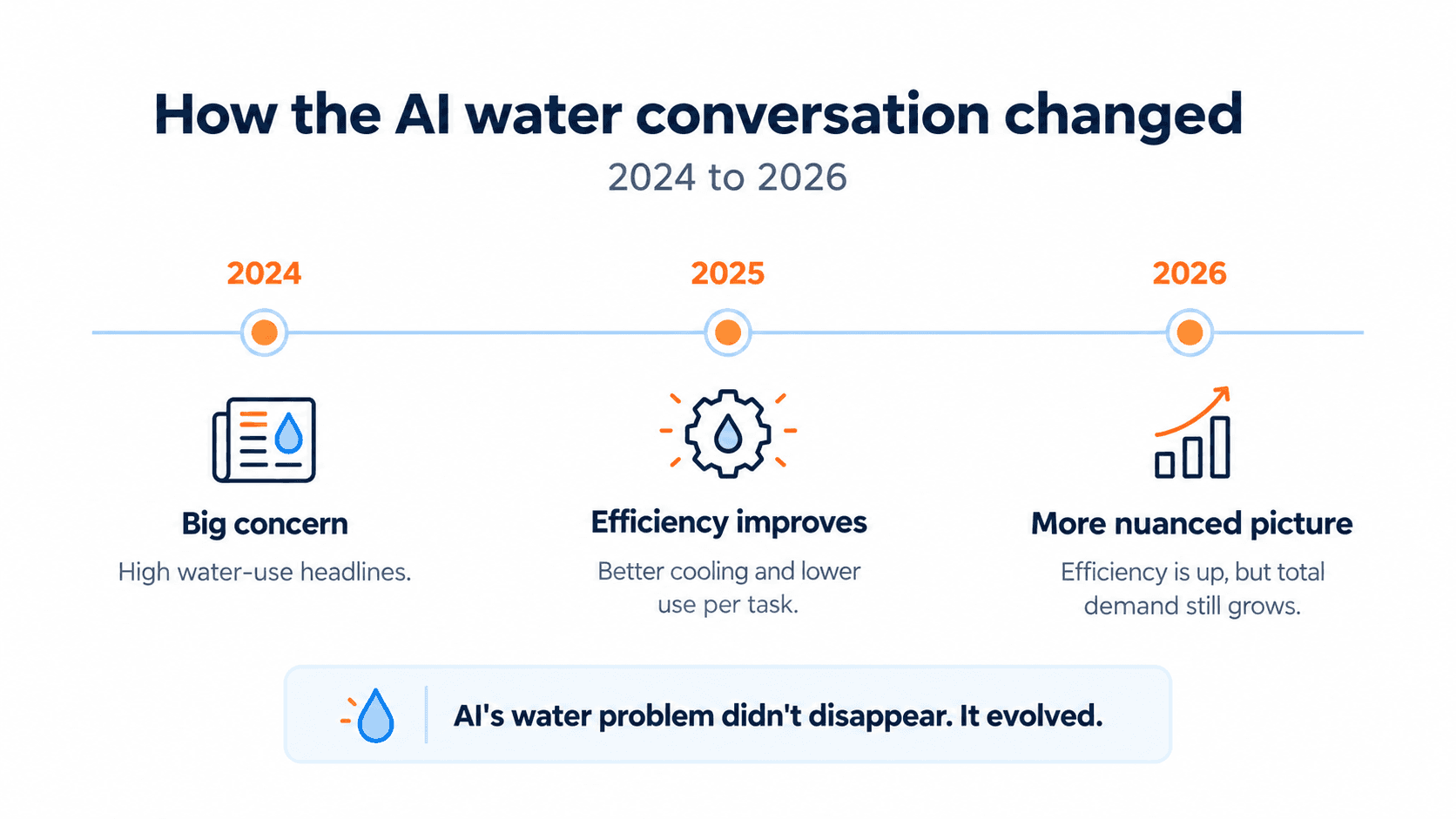
In August 2025 Google published a measurement of its own inference, covering the median Gemini Apps text prompt in May 2025. It came to 0.24 watt-hours of energy, 0.03 grams of CO2 equivalent, and 0.26 millilitres of water. About five drops. Google also reported that energy per median prompt had fallen 33 times over the preceding twelve months, and emissions 44 times.
Both numbers can be right about the thing they measured. Between them sit three years of different chips, different model architectures, better use of the hardware, and redesigned cooling.
Two of the numbers in this article disagree by a factor of 170
Google's 0.26 ml is the company's own figure for its own product, and Google states in the same document that it has not been verified by an independent third party.
Set it next to Mistral. The French lab ran a lifecycle analysis of Mistral Large 2 with the consultancy Carbone 4 and the French environment agency ADEME, peer reviewed by two specialist auditors. It put a 400-token response from Le Chat at 45 ml of water, roughly 170 times Google's figure for a broadly similar job.
Both are credible. Neither is comparable to the other. They cover different models on different hardware in different countries, drawing different boundaries around what counts. One is a median short prompt, the other a fixed 400-token response carrying the full lifecycle of the model.
A single number for what an AI question costs in water does not exist. Anyone quoting one without naming the model, the method and the location is repeating something rather than reporting it, and that applies to the flattering numbers as much as the alarming ones.
In new buildings, the cooling problem is being designed out
The clearest progress is in the buildings themselves.
Microsoft began rolling out a design in August 2024 that uses no water evaporation for cooling. Liquid runs in a sealed loop between the chips and the chillers instead of evaporating away. Microsoft puts the saving at more than 125 million litres per data centre per year against its own fleet average, with pilots in Phoenix and Wisconsin during 2026 and sites online from late 2027.
Amazon Web Services reports water use per unit of computing falling from 0.25 litres per kilowatt-hour in 2021 to about 0.12 in 2025.
OpenAI and Anthropic are both specifying closed-loop cooling for new sites. OpenAI says its Abilene buildings take a one-off fill and then recirculate, with ongoing cooling water comparable to an office building. Anthropic's Australian campus, announced this month, is air-cooled on the same principle.
Microsoft is also open about the trade-off, which is the part usually left out. The heat still has to go somewhere, and mechanical cooling uses more electricity than evaporation. Electricity carries its own water footprint at the power station, so some of what leaves the data centre reappears on the grid.
Efficiency per query and total demand are different numbers
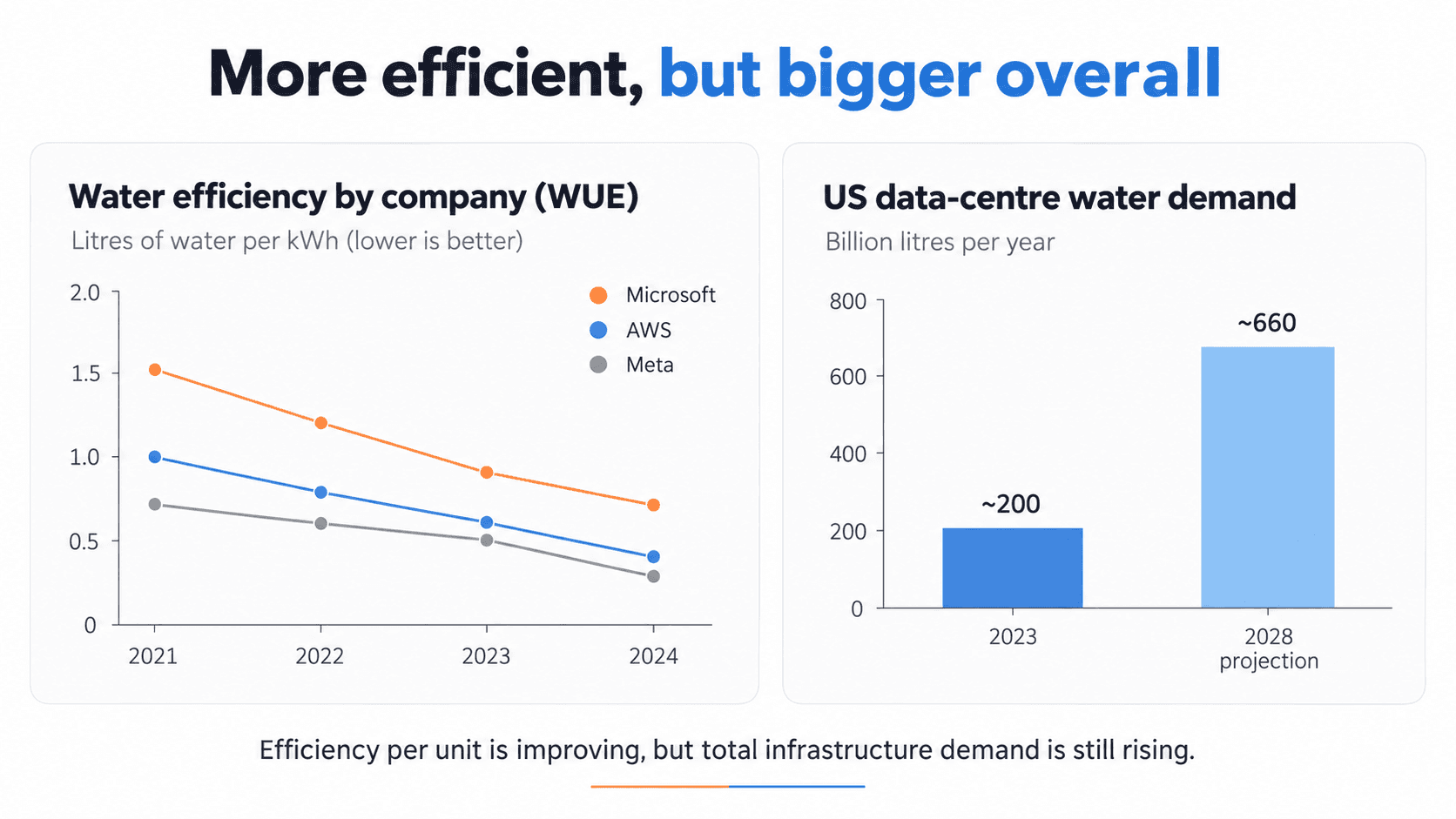
Google's own reporting shows both directions at once. It replenished about 1 billion gallons of water in 2023, covering 18% of its fresh water consumption, then 4.5 billion in 2024 covering 64%, then 7.7 billion in 2025 covering 78%.
Read those percentages backwards and implied total consumption rises from roughly 5.6 billion gallons to roughly 7 billion to roughly 9.9 billion. They are approximations from rounded figures rather than audited totals, and they point one way.
So the company that cut energy per prompt 33-fold in a year appears to be consuming close to twice the fresh water it did two years earlier. Efficiency is measured per unit of work, and the work keeps growing faster. The engineering is improving quickly. The building is happening faster.
In the UK the argument is about where, not how much
Britain's version of this question is about maps more than litres.
The government designated data centres as Critical National Infrastructure in September 2024, putting them alongside water and energy in planning terms. Before that, Thames Water had objected to some data centre applications and warned operators about restrictions during heatwaves.
The first designated AI Growth Zone is at Culham in Oxfordshire, about seven miles from the site of a planned reservoir at Abingdon, in an area supplied by Thames Water and classified as seriously water stressed. The south east holds most existing data centre capacity and much of what is planned, because that is where the fibre, the grid connections and the customers are.
A litre evaporated in a wet part of the country and a litre evaporated in the Thames Valley in August are the same litre on a spreadsheet and different things on the ground.
The British figures are contested too
The number most often quoted in UK coverage is a projected shortfall of nearly 5 billion litres of water a day in England by 2050, from a report published through the Government Digital Sustainability Alliance in September 2025.
Computer Weekly went back to the source and found the figure comes from the Environment Agency's baseline dataset, before planned interventions. The final planning dataset for the same period projects a surplus of 895 million litres a day. The report cited the first and not the second, which the article called cherry-picking.
Underneath both versions sits a simpler problem. Only about two-fifths of data centre operators track their water use at all, and Defra told Parliament in July that it is still building the evidence base.
Britain is arguing about projections to 2050 while lacking reliable figures for last year. In Texas, where reporting is mandatory, the governor ordered regulators on 14 September to pursue penalties against data centres ignoring the survey, after compliance sat around 30%. Transparency is the live issue in both countries, ahead of consumption.
What this means for a business using AI
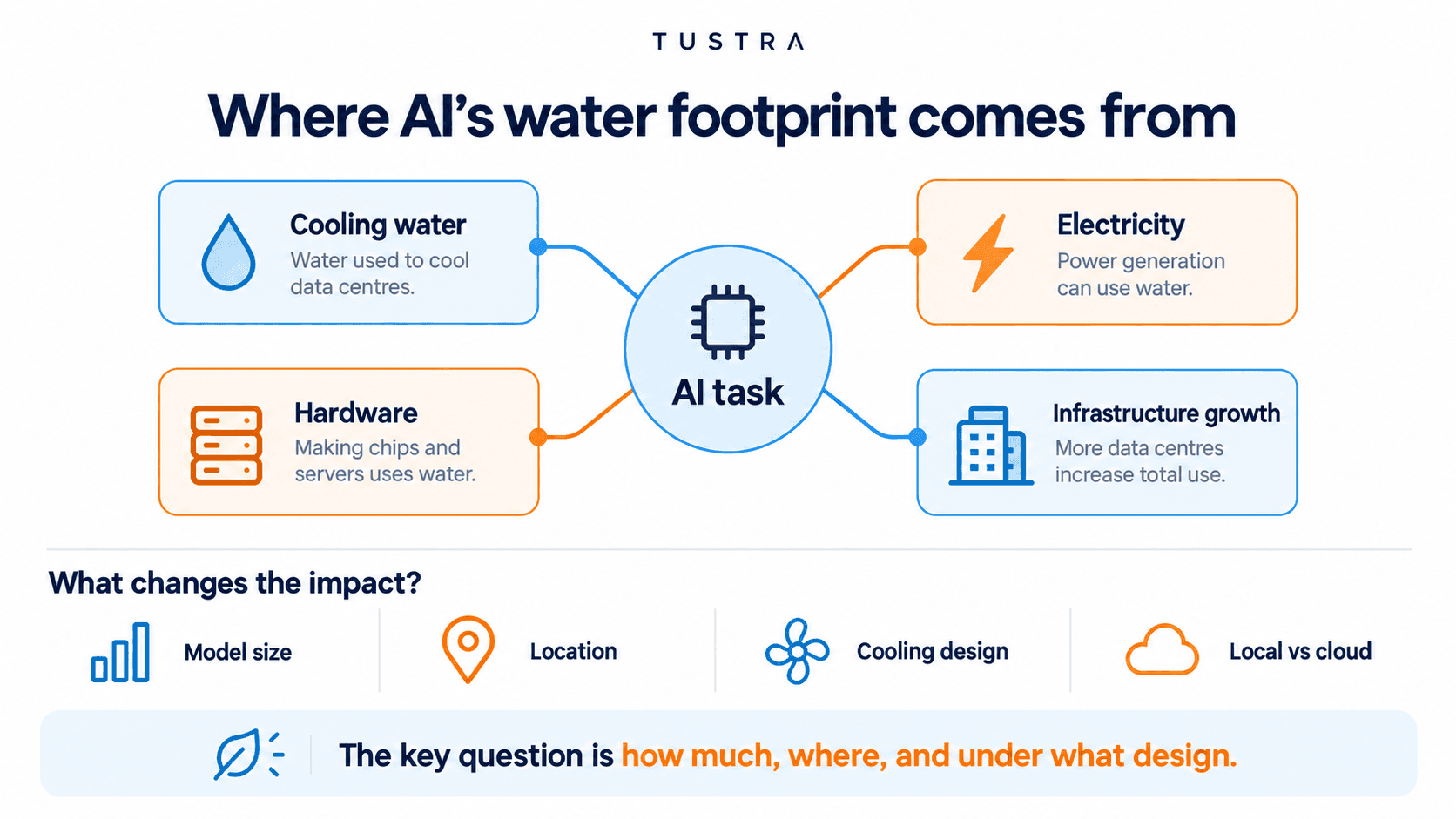
For an ordinary business this rarely shows up as a water decision. It shows up as an engineering one, and the environmental part follows.
The pattern worth noticing is how much work gets sent to a large model that does not need one. Classifying an email. Pulling an invoice number out of a PDF. Applying a rule with no judgement in it. Running an agent where a fixed sequence of steps would do the job.
A well-built system uses ordinary code where the logic is fixed, a small model for sorting and extraction, and a large one only where the task genuinely needs it. That arrangement is cheaper, faster, and easier to test when something breaks. It also uses a fraction of the computing power, which is where energy and water come from. The environmental case arrives as a side effect of building the thing properly.
The subject went quiet without being settled
Water is no longer the loud argument about AI. The loud argument is pace, after Dario Amodei published an essay on 12 September calling for frontier labs to slow down enough for safety work to keep up, Sam Altman and Elon Musk agreed in public, and Mark Zuckerberg rejected the idea three days later.
The water question did not resolve. It stopped being simple, and simple is what carries a headline. A single query costs far less than the 2023 figures suggested, new data centres can be built to evaporate almost nothing, total consumption is still climbing because construction is outrunning efficiency, and nobody in Britain can say with confidence how much water the industry used last year.
The next time a figure about AI and water appears, the question worth asking is which model it measured, in which country, and who checked it.
FREE EMAIL BRIEFING
The Tustra Briefing
AI in plain English for UK business.
One considered briefing covering what changed, why it matters, how businesses are using it, what to be cautious about and one practical action worth considering.
Important developments without daily noise
Practical UK business context
Honest case studies, security and adoption guidance
Blog
Recent Articles
AI automation insights to help your business move faster and smarter.

